a blog for genealogists, historians and those who love all things Italian!
Wednesday, March 19, 2014
Sunday, March 16, 2014
Working with the Documents - Part III - Civil Birth Record of Aurelia di Marco
Birth Record of Aurelia di
Marco
Aurelia’s birth was reported to the
Altomonte town hall on 13 November 1818 at 12:00 p.m. by her father, Rafaele di
Marco. Rafaele was forty years old [born about 1778], a farmer, and resident of
this town on Vallina Avenue.
He declared that the female child he
was presenting was born “the day before indicated” [13 November 1818 ?] at
12:00 p.m. in his home and to his wife, Cherubina Perrone. Cherubina was thirty
years old [born about 1788].
The child was given the name
Aurelia. The witnesses to the presentation and declaration were: Domenico
Paladino, age sixty, a farmer, and resident of this town on Vallina Avenue as
well as Saverio Costante, age forty-six, a shoemaker, and resident of the town
on Vallina Avenue. Rafaele and both witnesses made their marks on the bottom of
the document, as they were not literate.[1]
COMMENTS: Rafaele
was born about 1778 while Cherubina was born about 1788. Rafaele was not literate so he could not verify that their ages were recorded correctly.
A “di” not a “De” was used in
Rafaele’s surname [as seen in other records of this family]. They both mean the same thing in the Italian language, “of”
or “from.” Capitalization was often used interchangeably when a “Di” or “De” preceded
a surname and does not change the translation. This type of surname is
patronymical, meaning they were likely the descendants of a Marco. Italians began
using surnames at different points in time over the last four hundred years,
depending on the locality. Patronymical surnames are just one form of surname
seen throughout Italy.
Aurelia may have been born on
12 November 1818. The document says that she was born on “the day before
indicated” [logically meaning the date of recordation, 13 November 1818] yet
they say that the child was presented on that exact date and time. It is unlikely that the father grabbed the
child and ran to the town hall the moment she was born.
[1]
Altomonte, Cosenza
Province, Italy, “Registro di Atto di Nascita [Register of Acts of Birth],
1818,” record 64, birth record of Aurelia di Marco; Family History Library microfilm
#1,329,794.
Thursday, March 13, 2014
Working with the Documents - Part II - Another Civil Marriage Record
Transcribed Marriage Promise of Francesco Antonio Labbollita and Maria Rosa Cordasco
This couple appeared in the Altomonte town hall on 25 June 1820 at 2:00 p.m. to record their marriage promise. The groom was Francesco Antonio Labbollita, age forty-five [born about 1775], a farmer, born in Altomonte, and a resident of Altomonte on San Nicola Avenue. He was the son of the deceased Cherubina Labbollita, a seamstress and resident of this town, and an unknown father.
The bride was Maria Rosa Cordasco, age thirty-five [born about 1785], born in Altomonte, and a resident of Altomonte on San Nicola Avenue. Her parents were Giuseppe Cordasco, a farmer and resident of this town, and Maria Angela Pitrelli, a resident of this town. Both of her parents were deceased.
Their first marriage bann was posted on 21 May 1820. The documents that were to be attached to the marriage promise were:
- The birth record of the groom.
- The birth record of the bride.
- Death record of Rosa Guerzino [?], second wife of the groom, who died on 24 August 1819 [?].
- Death record of the groom’s mother who died on 4 September 1814.
- Death record of the bride’s mother who died on 26 September 1819.
- Death record of the bride’s father who died on 8 January 1810.
- The marriage bann and declaration of no opposition.
The witnesses to the recording of the marriage promise were: Gaetano Battaglia, age thirty-seven, a carpenter, and resident on San Nicola Avenue; Nicola Zaccarrelli, age [illegible], a shoemaker, and resident on the above-named avenue; Pasquale Franco, age twenty-three, a municipal employee, and resident on San Giacomo Avenue; and Vincenzo Adamo, age twenty-six, a mason, and resident on San Nicola Avenue. The groom, bride, and last witness were not literate and they made their marks at the bottom of the document. The other witnesses signed their signatures.
They then married in the Parish of San Giacomo Apostolo Maggiore the next day [26 June 1820] before the witnesses: Filippo Battaglia and Antonio Paladino. Their marriage was recorded in the parish records on 27 June 1820 as number [not given], on pages 197-198.[1]
COMMENTS: It is not unusual to
see the exact death dates for each parent given within a marriage promise and this may be a local practice. Normally, they are simply noted to be deceased and that they were including their death records in the marriage supplements. Having this information, will make researching for these records easier and can be used as additional evidence that the death records found are the correct ones.
Please note that this was
Francesco Antonio’s third marriage. The death record of his first wife was
required to be included when he married the second wife so therefore it was not
required when he married his third wife, Maria Rosa Cordasco. His third marriage followed within a year of his second wife’s death, likely an
indictor that there were small children in the household needing care.
This couple’s estimated ages
in this record puts Francesco Antonio’s birth about 1771 and Maria Rosa’s about 1778. This marriage record is a strong form of evidence. However,
since Francesco Antonio and Maria Rosa were both illiterate, they could not
verify that their ages were recorded correctly. This should be kept in mind when evaluating the document's evidentiary value.
The witnesses to an Italian
couple’s parish marriage were often the godparents to their first child or two.
[1]
Altomonte, Cosenza
Province, Italy, “Registro di Atto di Matrimonio [Register of Acts of
Marriage], 1820,” record 23, page 23, transcribed marriage promise for
Franscesco Antonio Labbollita and Maria Rosa Cordasco; Family History Library microfilm
#1,329,794.
Wednesday, March 12, 2014
Friday, March 7, 2014
Working with the Documents - Mining an Italian Marriage Record for Useful Clues
There's nothing like working with multiple documents to increase your knowledge of Italian research.
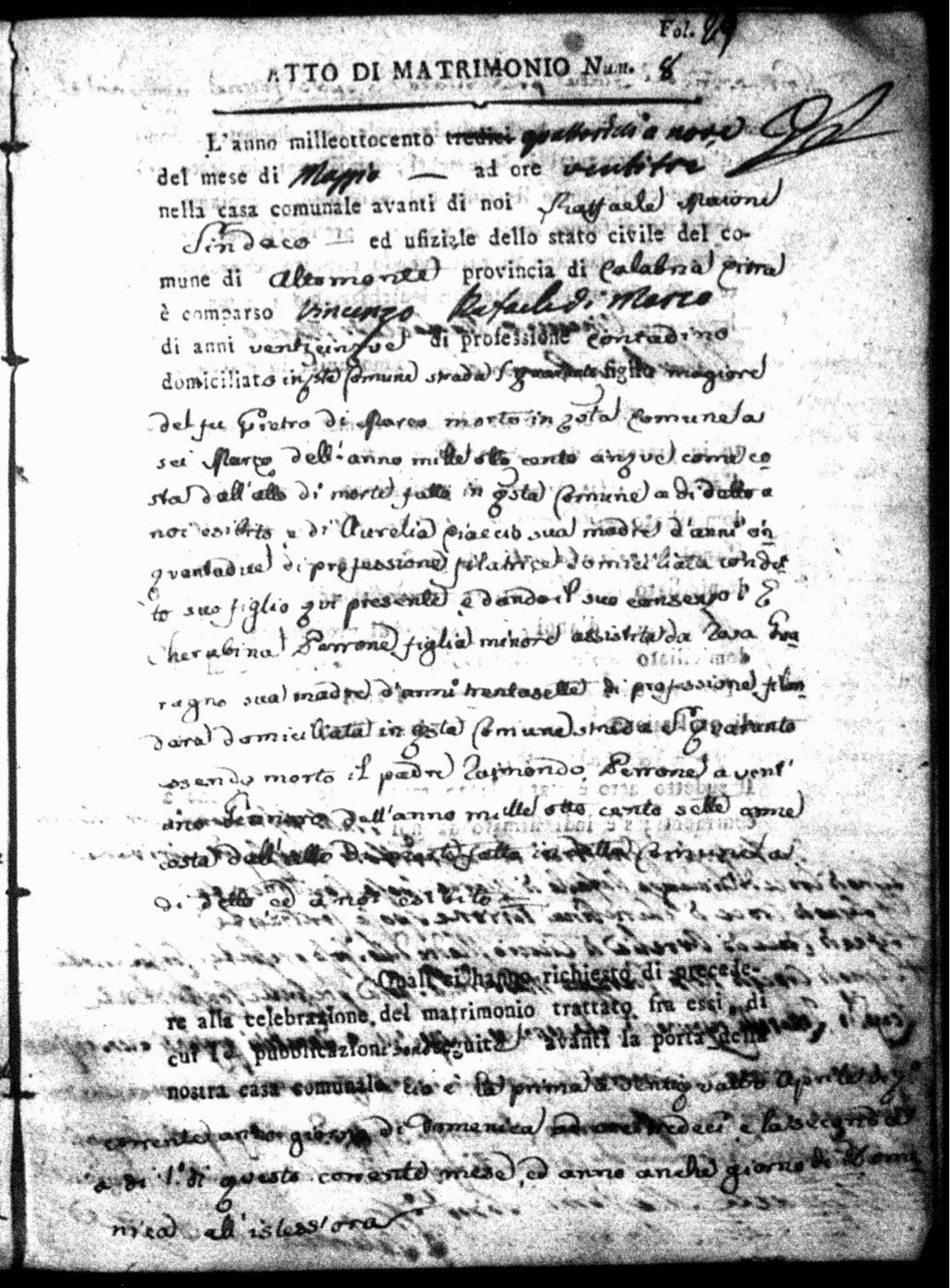
I find it interesting when a civil record provides more information than was required by law. Below is a translated abstraction of the marriage record of Vincenzo Rafaele di Marco and Cherubina Perrone. The abstraction includes all genealogically useful information from the document. The unusual portions and a clue that might lead to additional information [including my explanations] have been highlighted in purple.
Marriage Record of Vincenzo
Rafaele di Marco and Cherubina Perrone
This couple appeared in the
Altomonte town hall on 9 May 1814 at 11:00 p.m. to be married. The groom was Vincenzo Rafaele di Marco, of legal age, age twenty-five
[born about 1789], a peasant farmer, and resident of this town on San Quaranto
[?] Avenue. He was the son of the deceased Pietro [di Marco], who died in this
town on 6 March 1805 but whose death record does not exist, as well as the
living Aurelia Ciaccio, age forty-two [born about 1772], a seamstress, and
resident of Altomonte in the household of her son, the groom. They note that
his mother gave consent for the marriage [even though this wasn’t necessary
because he was of legal age.]
The bride was Cherubina Perrone, a
minor [no age given]. Her parents were the living Rosa Guaragno, thirty-seven
years old [born about 1777], a weaver, and resident of this town on San
Quaranto Avenue as well as the deceased Raimondo Perrone, who died in this town
on 21 January 1807 but whose death record does not exist.
The first marriage bann was posted
on Sunday, 24 April 1814 and the second bann on Sunday, 13 [?, ink bleed-through]
May 1814. There were no oppositions to the marriage.
The witnesses were: Leopoldo
Lattarchi, age thirty-four, a priest, and resident of this town on Pequaria [?]
Avenue; Giuseppe Adamo, age forty-four, a mason, and resident of this town on
[illegible] Avenue; Vincenzo Maione, age forty-seven, an Archpriest, and a
resident of this town on Pequaria [?] Avenue; and Carmelo Guaragno, age thirty,
a municipal employee, and a resident of Morano [perhaps Morano Calabro] on La
Piazza Avenue.
The bride, groom, and their mothers
were present but could not write. They each made their mark at the bottom of
the document.[1]
COMMENTS: Interestingly, this
document was not in the form of a marriage promise, as is usually seen in this
part of Italy prior to 1865.
They apparently looked for the death records of
both fathers, as they would do for any marriage, but neither death record was
found. It is unusual for them to include the exact dates of death for each father within the actual marriage document. Normally, they would just be marked as deceased and their death records included in the marriage supplements. They may have given the information within the marriage document because their death records could not be found.
There was a lot of ink
bleed-through from the other side of this document that made the bottom section
of page 1 difficult to read.
The last witness may be a
relative of the bride’s mother, as their surnames are the same. It is unlikely
that this man worked for the town of Altomonte because Morano Calabro is a
little too far away for someone to travel to work on a daily basis, especially
in 1814 [see below]. It is likely he was a town employee in Morano Calabro. This may be a
clue as to the origins of the Guaragno family.
[1]
Altomonte, Cosenza
Province, Italy, “Registro di Atto di Matrimonio [Register of Acts of
Marriage], 1814,” record 8, page 29 [?], marriage record of Vincenzo Rafaele di
Marco and Cherubina Perrone; Family History Library microfilm #1,329,794.
Wednesday, March 5, 2014
Dizionario di Abbreviature latine ed italiane [Dictionary of Latin and Italian Abbreviations], seventh edition, by Adriano Cappelli
The Dizionario di Abbreviature latine ed italiane [Dictionary of Latin and Italian Abbreviations] by Adriano Cappelli can be a valuable resource for your research, most especially when translating Latin parish records.
The seventh edition of this manual offers more to the eye than anticipated. Included are nine foldout documents on which to practice interpreting and translating.
The book's explanations are in Italian, except in the Latin abbreviations section. The dictionary shows the abbreviations in paleographical examples, then in typographical form, and ends with the full word it is trying to indicate.
The book can be purchase on Amazon.com or Amazon.it.
Wednesday, February 26, 2014
Wednesday, February 19, 2014
Subscribe to:
Comments (Atom)