Friday, March 7, 2014

Working with the Documents - Mining an Italian Marriage Record for Useful Clues

There's nothing like working with multiple documents to increase your knowledge of Italian research.

I find it interesting when a civil record provides more information than was required by law. Below is a translated abstraction of the marriage record of Vincenzo Rafaele di Marco and Cherubina Perrone. The abstraction includes all genealogically useful information from the document. The unusual portions and a clue that might lead to additional information [including my explanations] have been highlighted in purple.
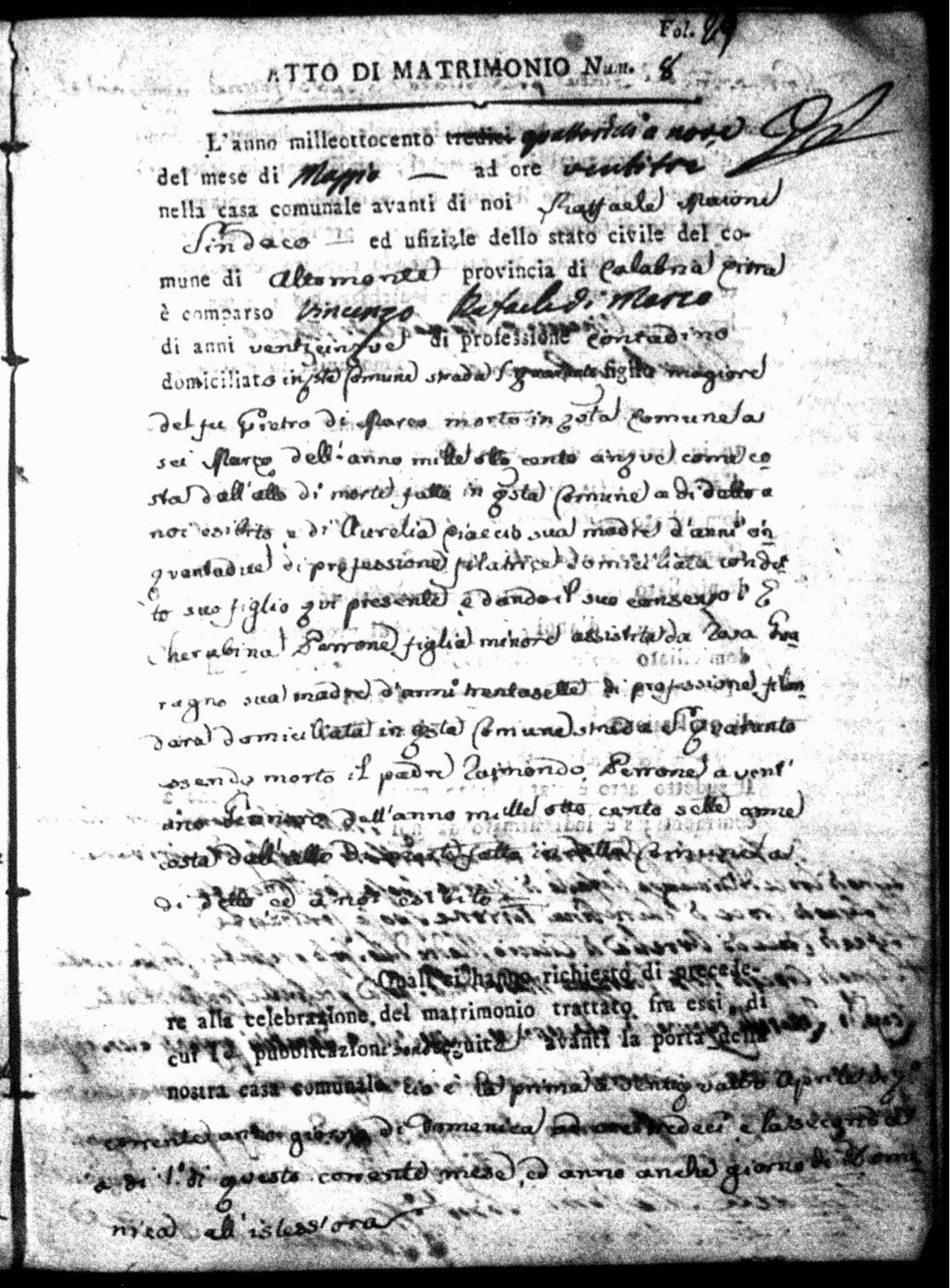


Marriage Record of Vincenzo Rafaele di Marco and Cherubina Perrone

            This couple appeared in the Altomonte town hall on 9 May 1814 at 11:00 p.m. to be married. The groom was Vincenzo Rafaele di Marco, of legal age, age twenty-five [born about 1789], a peasant farmer, and resident of this town on San Quaranto [?] Avenue. He was the son of the deceased Pietro [di Marco], who died in this town on 6 March 1805 but whose death record does not exist, as well as the living Aurelia Ciaccio, age forty-two [born about 1772], a seamstress, and resident of Altomonte in the household of her son, the groom. They note that his mother gave consent for the marriage [even though this wasn’t necessary because he was of legal age.]

            The bride was Cherubina Perrone, a minor [no age given]. Her parents were the living Rosa Guaragno, thirty-seven years old [born about 1777], a weaver, and resident of this town on San Quaranto Avenue as well as the deceased Raimondo Perrone, who died in this town on 21 January 1807 but whose death record does not exist.

            The first marriage bann was posted on Sunday, 24 April 1814 and the second bann on Sunday, 13 [?, ink bleed-through] May 1814. There were no oppositions to the marriage.

            The witnesses were: Leopoldo Lattarchi, age thirty-four, a priest, and resident of this town on Pequaria [?] Avenue; Giuseppe Adamo, age forty-four, a mason, and resident of this town on [illegible] Avenue; Vincenzo Maione, age forty-seven, an Archpriest, and a resident of this town on Pequaria [?] Avenue; and Carmelo Guaragno, age thirty, a municipal employee, and a resident of Morano [perhaps Morano Calabro] on La Piazza Avenue.

            The bride, groom, and their mothers were present but could not write. They each made their mark at the bottom of the document.[1]

COMMENTS: Interestingly, this document was not in the form of a marriage promise, as is usually seen in this part of Italy prior to 1865. 

They apparently looked for the death records of both fathers, as they would do for any marriage, but neither death record was found. It is unusual for them to include the exact dates of death for each father within the actual marriage document. Normally, they would just be marked as deceased and their death records included in the marriage supplements. They may have given the information within the marriage document because their death records could not be found. 

There was a lot of ink bleed-through from the other side of this document that made the bottom section of page 1 difficult to read.

The last witness may be a relative of the bride’s mother, as their surnames are the same. It is unlikely that this man worked for the town of Altomonte because Morano Calabro is a little too far away for someone to travel to work on a daily basis, especially in 1814 [see below]. It is likely he was a town employee in Morano Calabro. This may be a clue as to the origins of the Guaragno family.


[1] Altomonte, Cosenza Province, Italy, “Registro di Atto di Matrimonio [Register of Acts of Marriage], 1814,” record 8, page 29 [?], marriage record of Vincenzo Rafaele di Marco and Cherubina Perrone; Family History Library microfilm #1,329,794.

Wednesday, March 5, 2014

Picture Wednesday - Monreale, Palermo Province, Italy


Dizionario di Abbreviature latine ed italiane [Dictionary of Latin and Italian Abbreviations], seventh edition, by Adriano Cappelli

The Dizionario di Abbreviature latine ed italiane [Dictionary of Latin and Italian Abbreviations] by Adriano Cappelli can be a valuable resource for your research, most especially when translating Latin parish records.

The seventh edition of this manual offers more to the eye than anticipated. Included are nine foldout documents on which to practice interpreting and translating.


The book's explanations are in Italian, except in the Latin abbreviations section. The dictionary shows the abbreviations in paleographical examples, then in typographical form, and ends with the full word it is trying to indicate.

The book can be purchase on Amazon.com or Amazon.it.

Sunday, February 9, 2014

Annotations in the Margin of Civil Death Records - Birth Record of Carmela Catanese


Annotations of marriage and death are often found in the margin of a civil birth record.  Sometimes, like in the record above, the notation was not made on the copy found in the Archivio di Stato [Provincial Archives]  but was made on the copy that is kept in the Comune [Town].

The documents available through FamilySearch were often microfilmed or digitized at the provincial archives, although some are becoming available that were found in the Comune or Tribunale [District Court].

The death record of Carmela Catanese, found on a FamilySearch microfilm and microfilmed at the provincial archives, contained no annotations in the margin.  However, the copy above that was found in the records of the Comune of Isnello did contain annotations for both her marriage [top left] and her death in the United States [bottom right].

I find it interesting that her U.S. death was recorded on this document. The marriage noted here was her second marriage which ended in divorce. She then went back to the U.S. [she'd immigrated before] and married a third time.  She lived nearly twenty years after she returned to America.  She must have maintained close ties with someone in Italy who cared enough to report her death.

Friday, February 7, 2014

The Riveli


Riveli are a type of census taken by the church for the purpose of taxing property and animals. If you've ever worked with these records they are amongst the hardest Italian records to understand. They can reveal interesting and surprising things about our ancestors. Let's take a look at a record for Francesco Catanzaro from Termini Imerese, Italy.

This record was found in the 1815 Riveli for the city of Termini Imerese in the Palermo Province. This record set has an index in the beginning so I was able to see that there was a record for a "Capn." [capitano or captain] Francesco Catanzaro. However, these records were not numbered nor recorded alphabetically. They were recorded as the individuals presented themselves and Francesco appeared on 25 September 1815.

Sometimes the names (and ages) of whole family groups are included, other times just the name of the landowner or the head of the sharecropping family is given.

Abbreviations were often used in these records, making them more difficult to translate and evaluate. As you gain experience, you'll know to look for certain words. The name of the subject of the record is often found on top. In this record, we see that this Riveli entry was for land in the contrada [hamlet] of DoVarita.  Francesco Catanzaro did not own the land but was share cropping it.  The names of the landowners are given also.

The title "Capn.," given for Francesco Catanzaro in this record, was the first indication that this ancestor may have had military service.  Further research showed a nine year gap between the birth of his second child and the birth of his third, another indication that he was absent from this family unit. One small notation on a Riveli, led to this possible revelation about this ancestor.  You never quite know where you will find that golden nugget of information!


Sunday, November 24, 2013

Civil Records of Northwestern Italy

The civil records available for this area of Italy through FamilySearch can be random and unpredictable.  They certainly are not currently as abundant as those from southern Italy and Sicily.

Some of this has to do with the inconsistency of how civil registration was kept in this area and access to records in the initial microfilming process.

I wanted to highlight a record set for this area, found within FamilySearch's catalog.

Estratti dei nati, notificazioni, e morti per varie regioni nel nord-ovest di Italia (Extracts of birth records, marriage banns, and death records for various regions in northwestern Italy)

The towns included are:

Imperia province - Borghetta di Arroschia, Dolceacqua, Camporosso, Isolabona, Pontedassio,Triora, San Remo, Ventimiglia

Cuneo province - Demonte, Roccavione, Limone Piemonte

Torino province - Lanzo Torinese

Novara province - Briga Novarise

Bergamo province - Carona

The records are in Italian and French and can be found on microfilm 1,075,768, Item 3.  A future post will discuss a few records from this record set.

Sunday, October 27, 2013

Italian Immigration to Philadelphia

A good source to understand this topic is the journal article "Aspects of Italian Immigration to Philadelphia" by Joan Younger Dickinson.  It was published in The Pennsylvania Magazine of History and Biography, Vol. 90, No. 4, October 1966, pp. 445-465.

You can purchase it from JSTOR at http://www.jstor.org/stable/20089965.

Can we find useful genealogical information in a journal article like this?  Here are a few subjects covered in this article that I think would be helpful for those researching Italians from this city.

1.  The names and opening years of the first Italian parishes in the city.  Helpful to determine which parish your ancestor might have attended.

2.  Where in the city and surrounding areas they congregated.

3.  Immigration waves and provinces of origin.

4.  Information on fraternal and other organizations whose goal it was to help Italians get established.

5.  A frank discussion on the padroni system.

6.  Information on living conditions.

7.  Occupational percentages.

8.  Citations pointing to other valuable sources of information.

These are but a few of the valuable subjects in this article and I encourage you to purchase and read it, even if your ancestors settled in a different part of the country.  Some of the information is universally useful, such as that on the immigration waves.

Sunday, August 25, 2013

Online Database of Available Ecclesiastical Records - La Memoria Dei Sacramenti

An exciting new initiative is making Italian ecclesiastical records more easily available and found.  The website is called La Memoria dei Sacramenti and is an interdiocese initiative to preserve these records and record where the original records can be found. 

This is not a digitization project but rather a portal through which to find what records are available for a particular parish, gain permission to research the records on-site, or through which to order extracts, certified copies, or digital images of the documents.  Additionally, each one of the registers will be indexed by name and you can perform a search of the database for your ancestor's records.

The website also provides a means of searching for parishes and civil jurisdictions (pre-1901) by the name of a particular town which may help you narrow down what parishes may need to be searched.

Still in the beginning stages, there is much work to do.  Currently, five regions have records within their database:
  • Liguria (currently only the province of Genova)
  • Sicilia (currently only the province of Enna)
  • Toscana (currently the provinces of Arezzo, Firenze, Grosseto, Livorno, Pisa, and Siena)
  • Sardegna (currently only the province of Cagliari)
  • Veneto (currently only the province of Vicenza)
Happy searching!!!

Wednesday, July 24, 2013

Annotations in the Margins of Italian Civil Birth Records

We often see annotations in the margins of civil birth records.  These annotations record the child's death and/or marriage.  Did you ever wonder how or if the second original set of these records were annotated?  This second set is held in the Tribunale or District Court for 70 years, then transferred to the Archivio di Stato of the applicable province.


The records of Santeramo in Colle, found on FamilySearch, provides a unique glimpse into the process.  Within their records they have a set of records they titled "Annotazioni di Morti 1866-1900" or Annotations of Death for the years 1866-1900.  These records show the document that the town civil record's office sent to the Tribunale.  From this record you can get not only the person's death date but often their birth date and/or the year and record number of the birth record.  The image below shows the request for annotation of death for a person born in Santeramo in Colle who died in the town of Acquaviva Delle Fonti.


Monday, June 3, 2013

Order Sons of Italy Death Benefit Enrollment Cards

The image below shows how much information about an ancestor can be derived from this resource:


The deceased was Lauranna [?] Teresa Cerminara who was a member of the Figli della Liberti Lodge.  She was the daughter of the deceased Antonino Cerminara and was forty-nine years old at her death on 18 October 1977.  She was part of the family of Giuseppe Cerminara (likely her husband), age fifty.

These records are available via Ancestry.com.

Birth Records in Trentino, Italy

There is a new website where a database of the birth records of Trentino, Italy are being posted.  It is still under construction but the project is exciting and will be very useful to those with ancestors from this town. 

Between 1815-1923, the parishes of this town kept the birth registers.  These records are what is being used for this project.  Versions of this webpage are available in Italian, English, Portuguese, Spanish, and others.

I've included a link to the project below!

Nati in Trentino - 1815-1923

Wednesday, May 22, 2013

Act of Birth on a Sea Voyage


While working in the region of Calabria, I found a new civil document I had never seen before, an Act of Birth on a Sea Voyage.  There isn't much to the pre-printed portion of the document as they left a very large section in the middle open to write in the specifics of the birth.


Malvito, the town where this record was found, is quite some distance from the sea.  Therefore, why this type of record was necessary is interesting.  Perhaps that is a question for those who have studied the history of this town or region.